Examples
All scripts live in examples/ and write their figures and animations to output/. Run them from the project root, for example python examples/07_3d_double_slit.py.
1. Gaussian barrier scattering
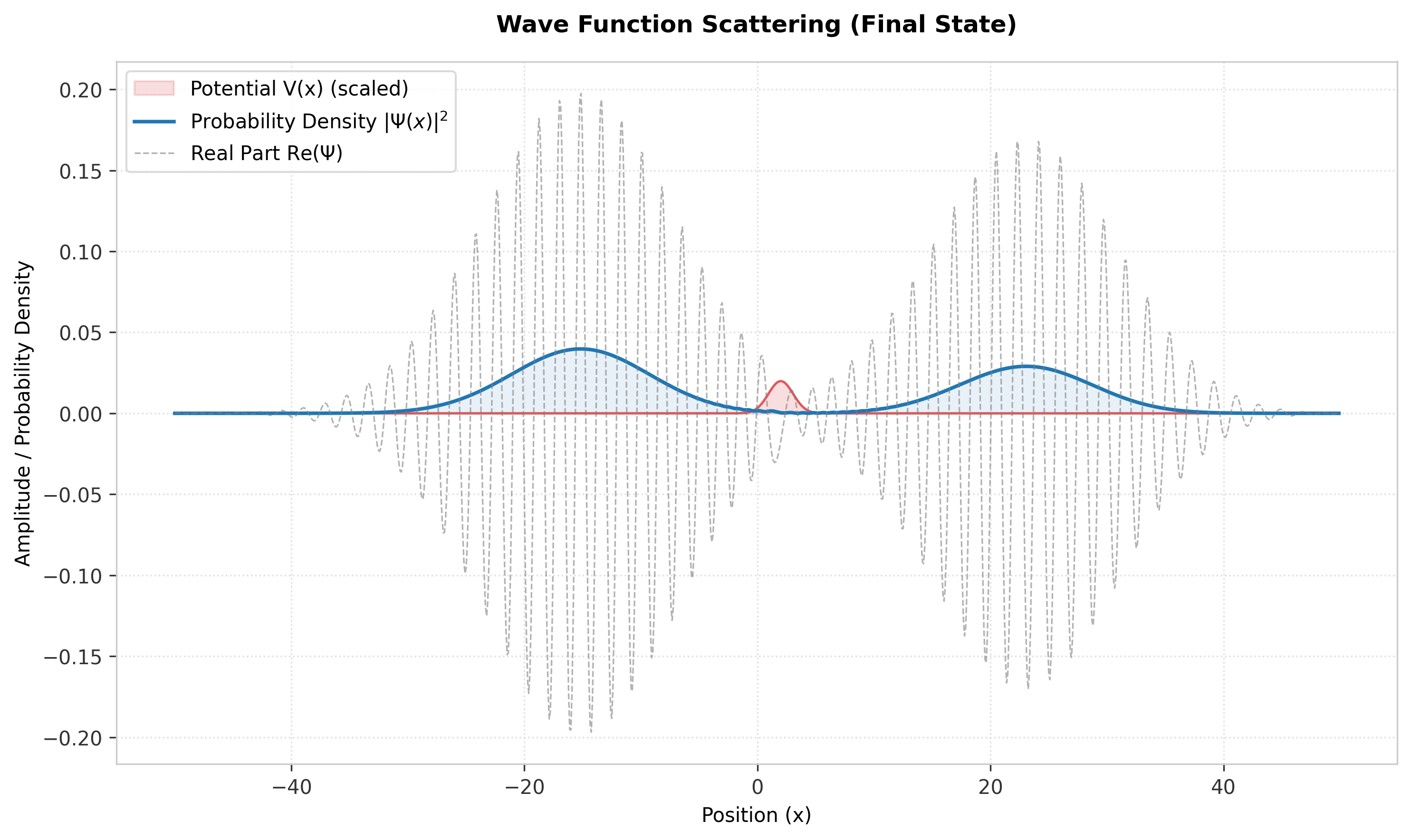
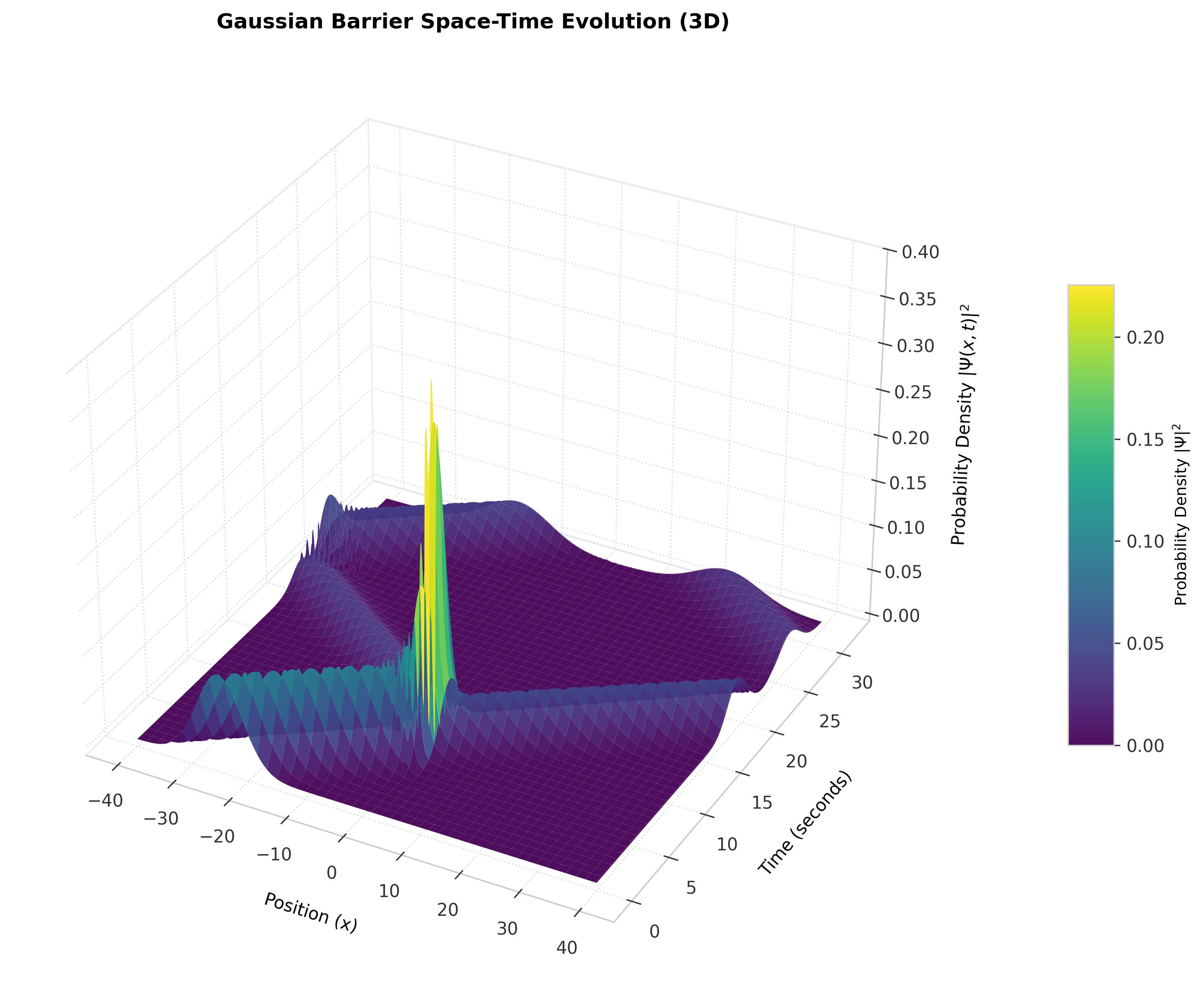
A 1D packet splits into reflected and transmitted parts, with R + T = 1 to six digits.
2. Harmonic oscillator
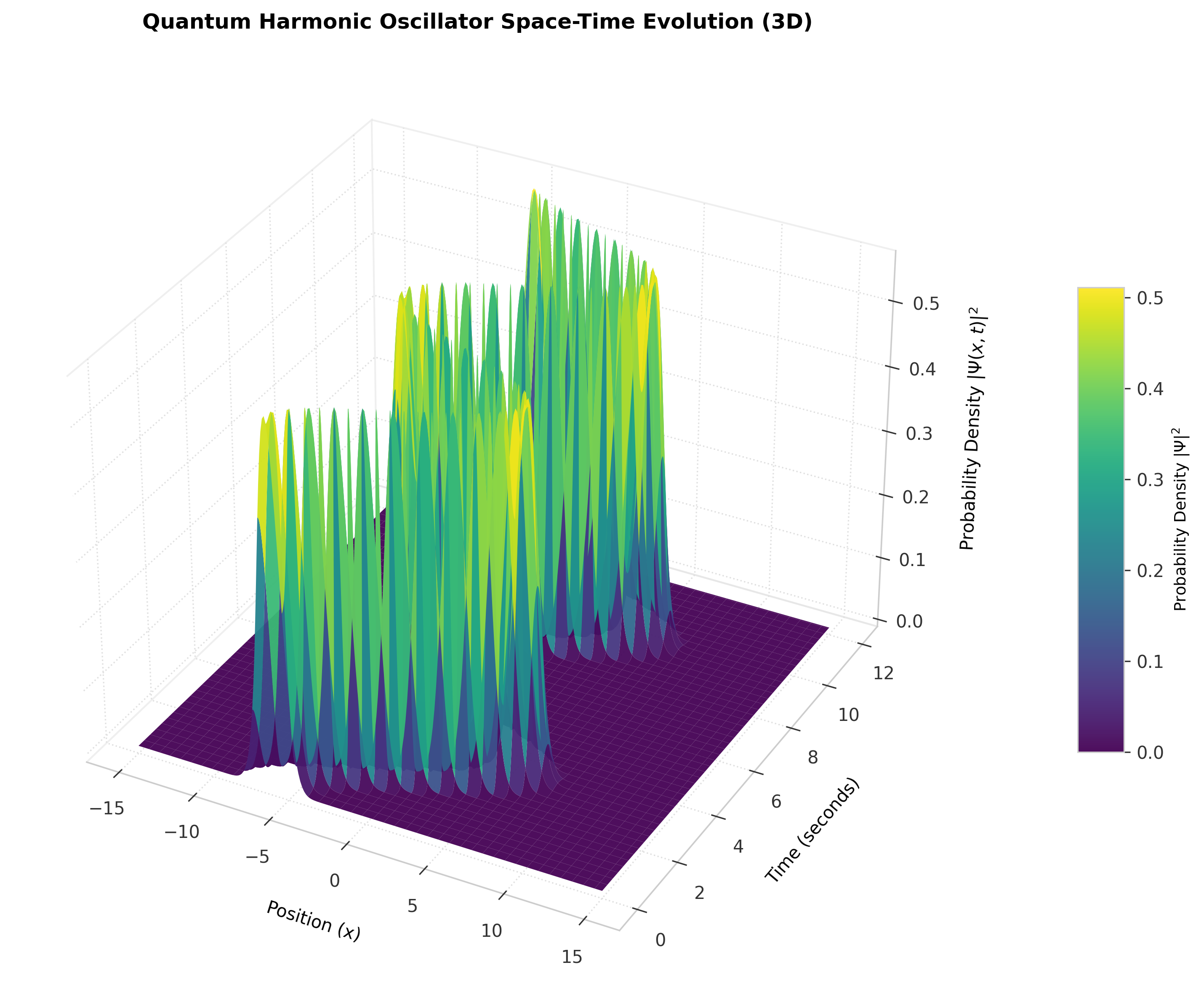
A coherent state oscillates in a parabolic well; the total energy is conserved to better than 10⁻⁵.
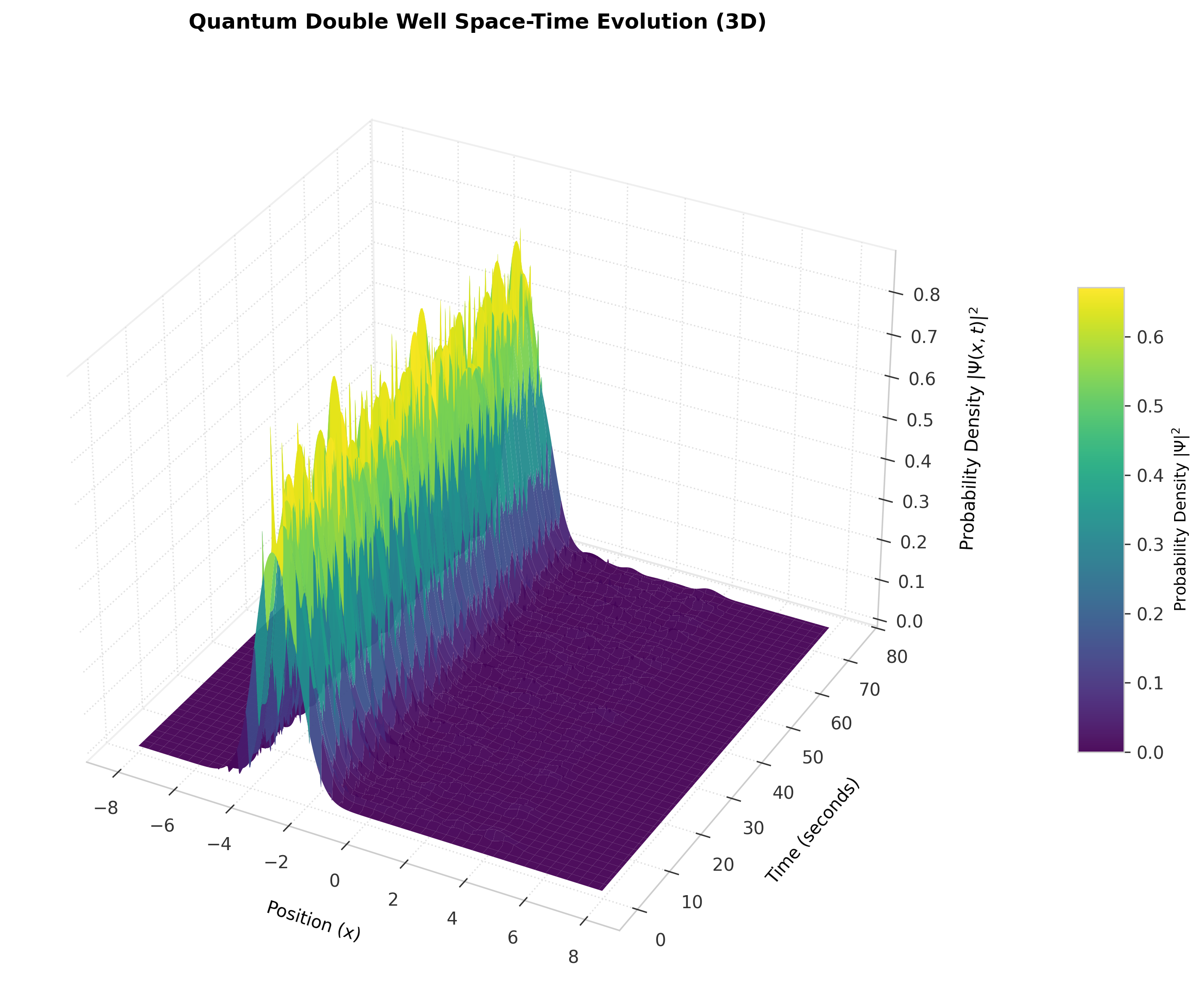
3. Double well
Tunnelling between two symmetric quartic wells.
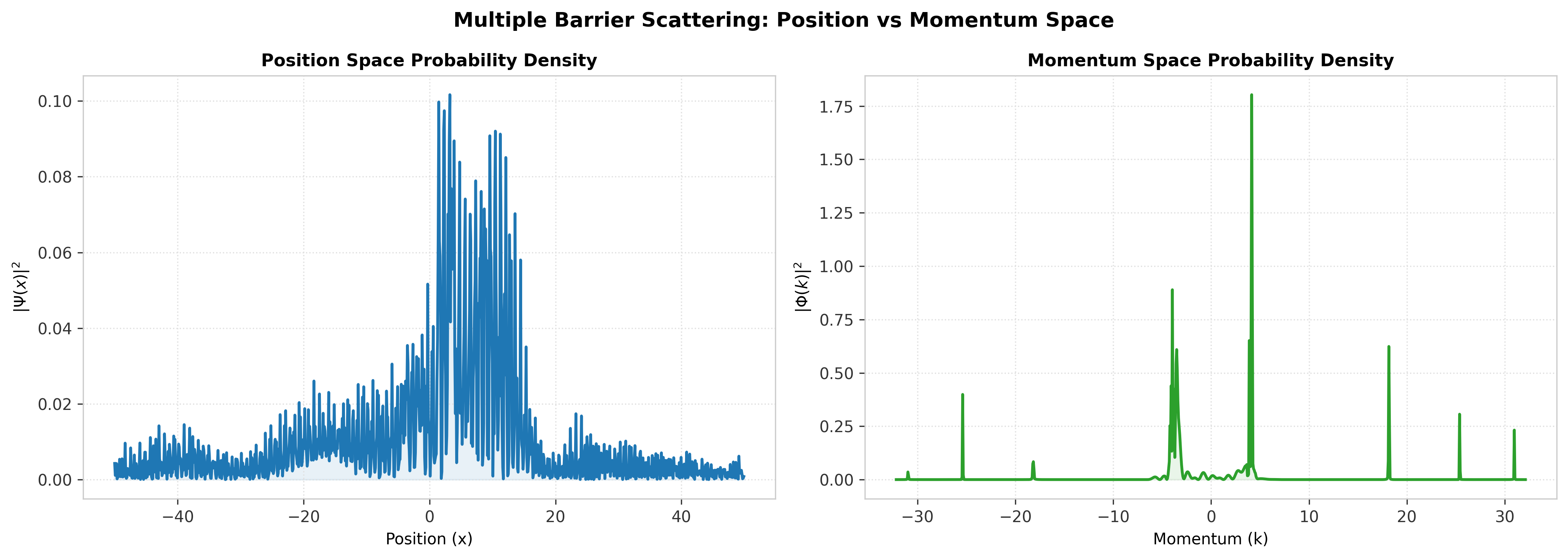
4. Multiple barriers
Interference fringes from scattering off a periodic barrier array.
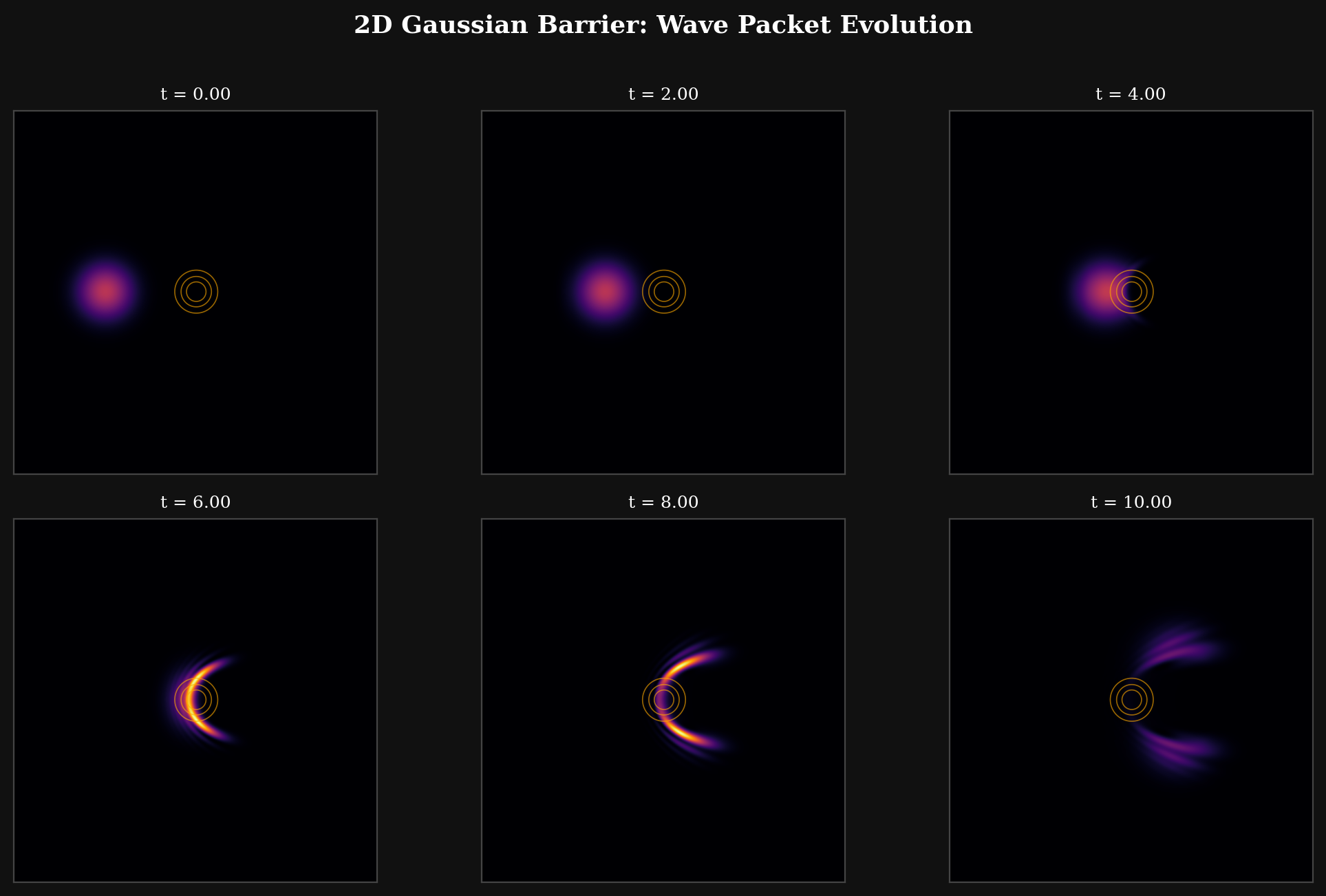
5. 2D Gaussian barrier
Diffraction around a radially symmetric barrier on a 256 × 256 grid.
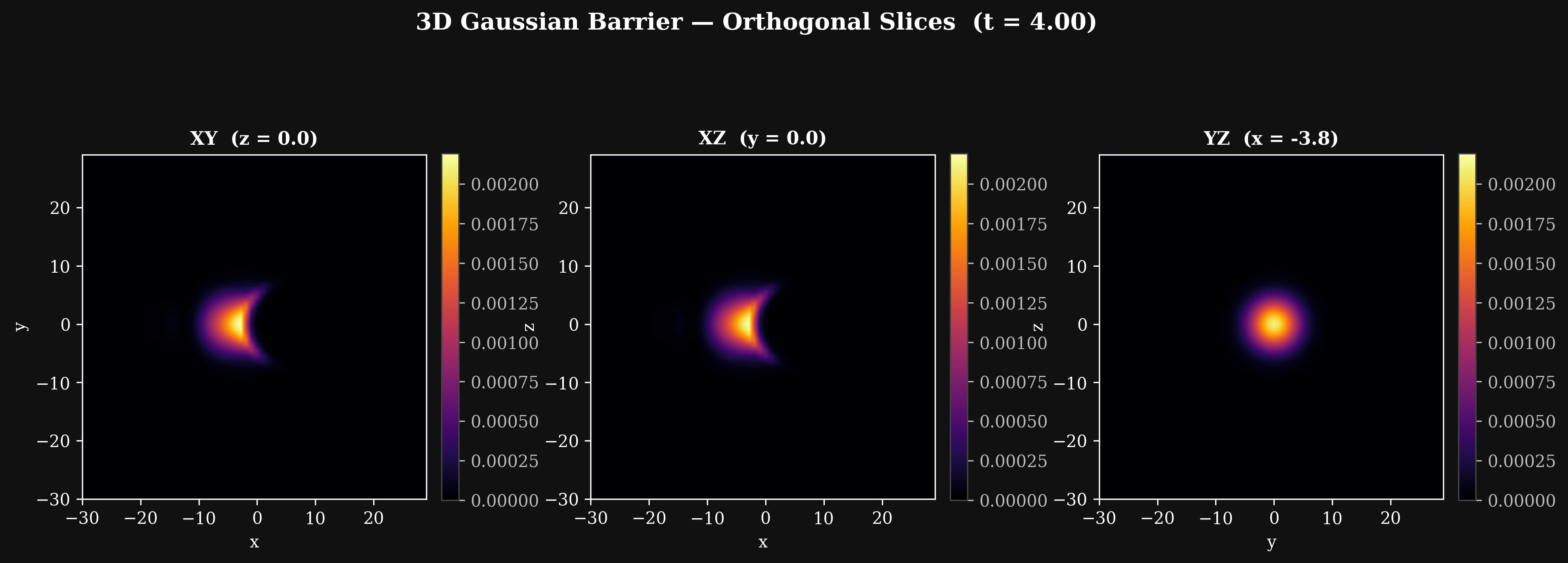
6. 3D Gaussian barrier
Orthogonal slices of a 3D packet scattering off a spherical barrier.
7. 3D double-pinhole interference
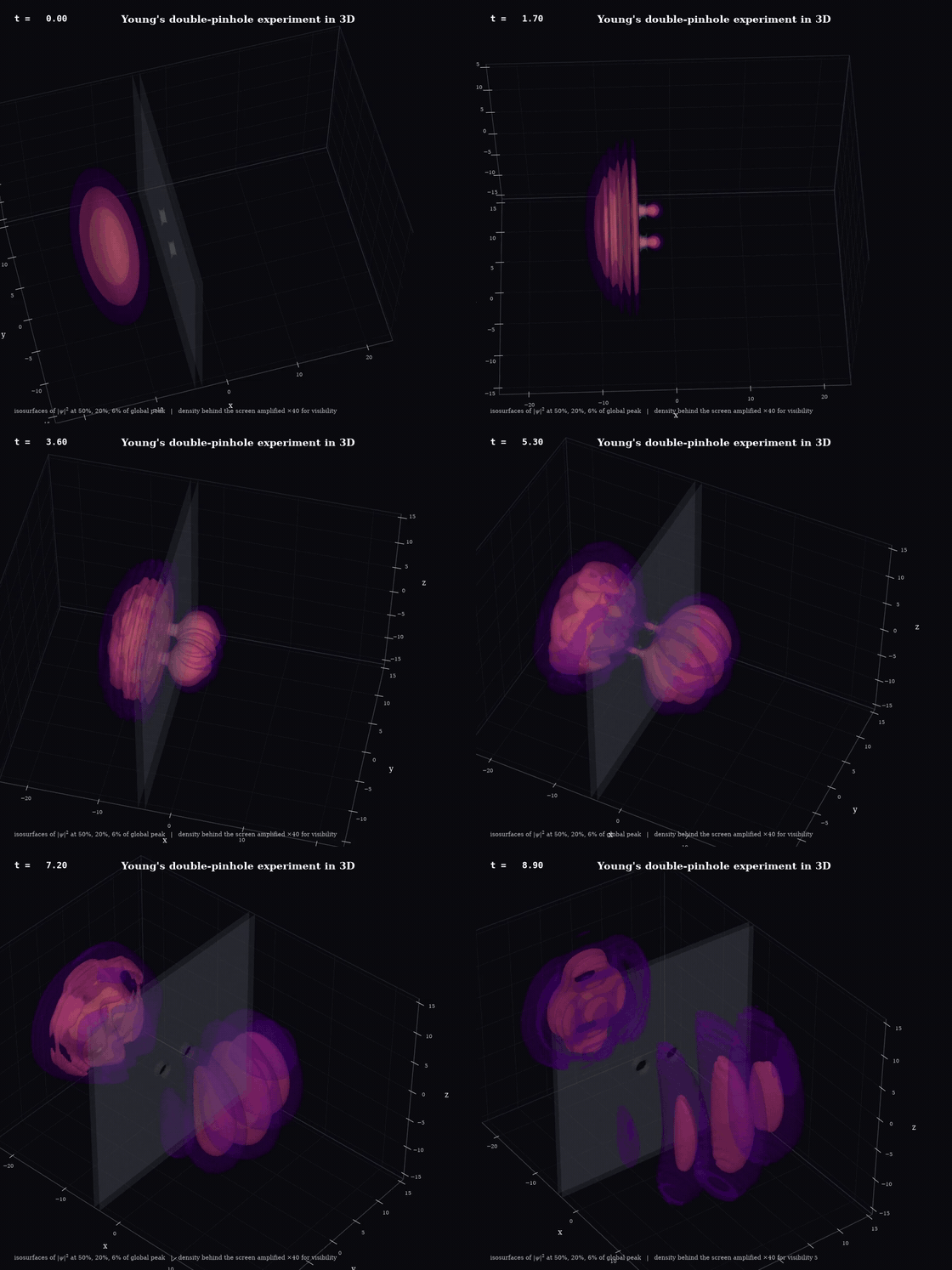
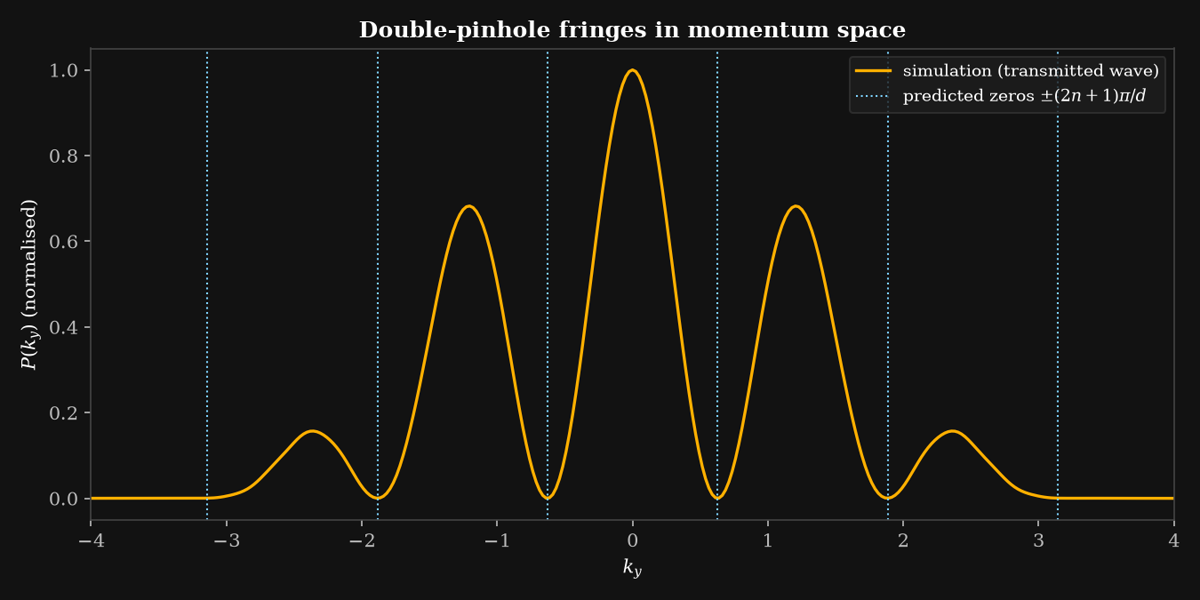
Young's experiment in full 3D on 1.2 million grid points. The fringe zeros of the transmitted momentum distribution lie within 1.6% and 0.3% of the Fraunhofer prediction ±(2n+1)π/d. The density behind the screen is amplified ×40 for visibility, as stated on every frame.
8. BEC time of flight
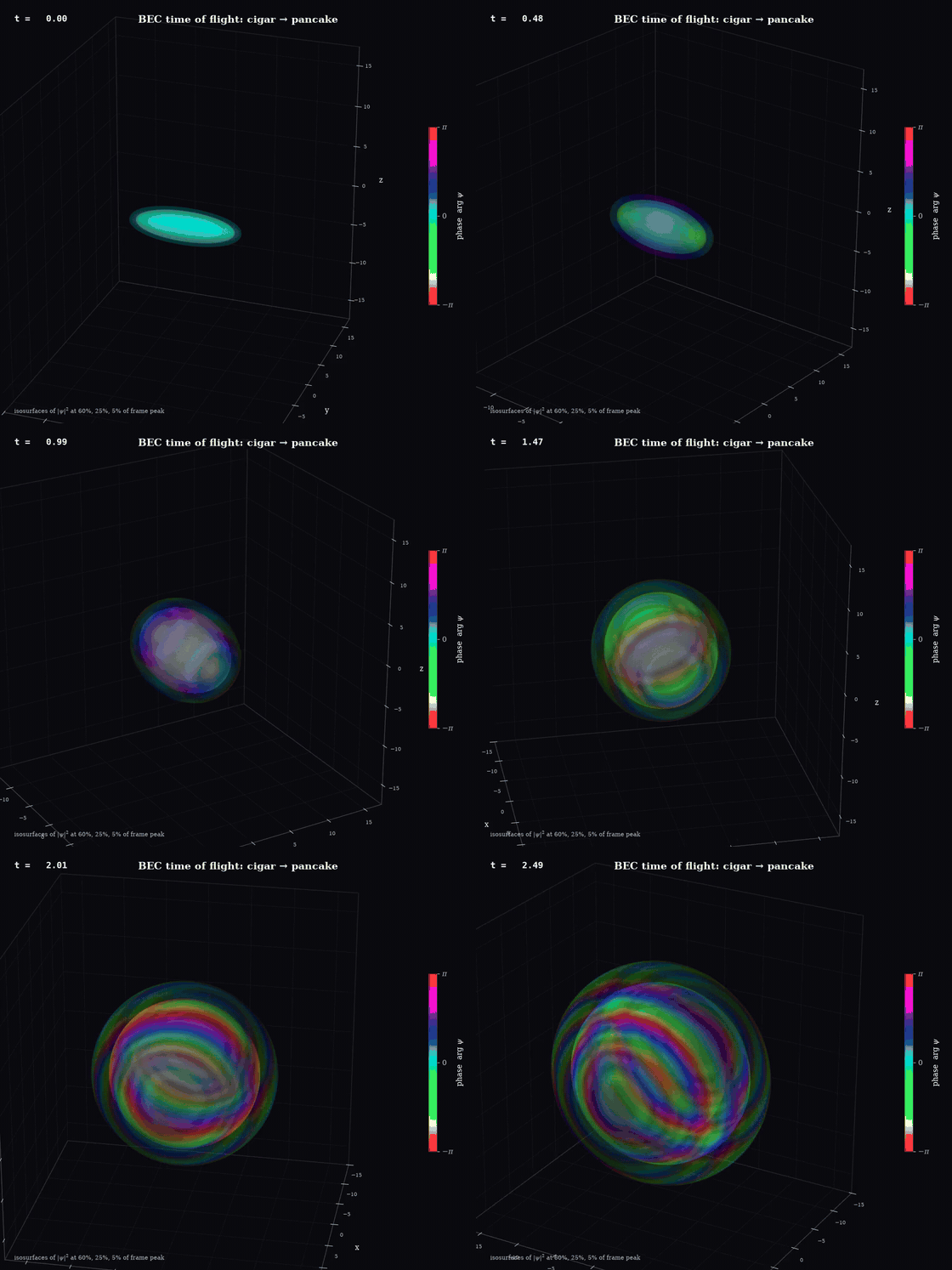
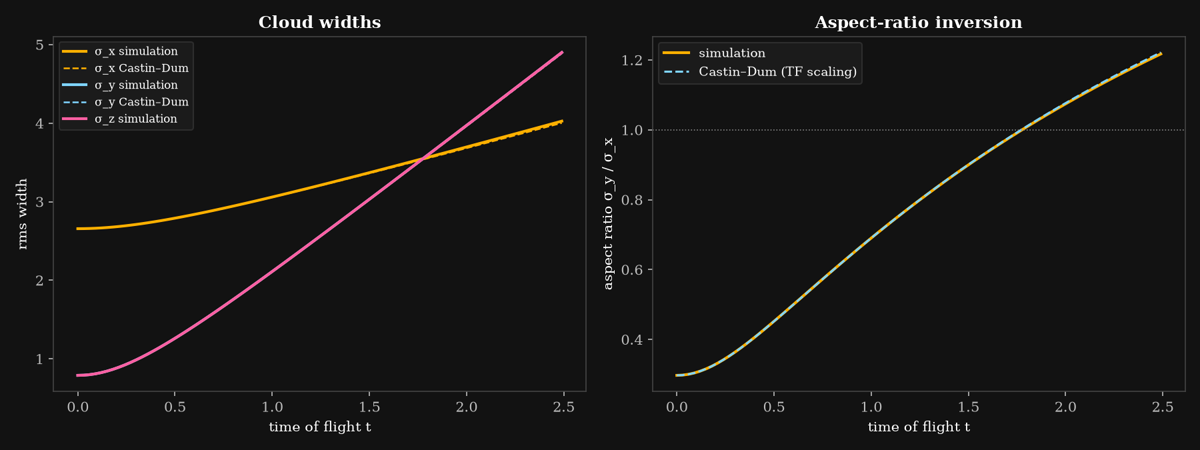
A Gross–Pitaevskii ground state in a cigar-shaped trap is released, and the cloud turns into a pancake. The aspect-ratio inversion happens at t = 1.776, against the Castin–Dum scaling prediction of 1.772. The rms widths follow Castin–Dum to within 0.6%, the ground-state virial theorem holds to 10⁻⁴, and the norm is conserved to 12 digits.
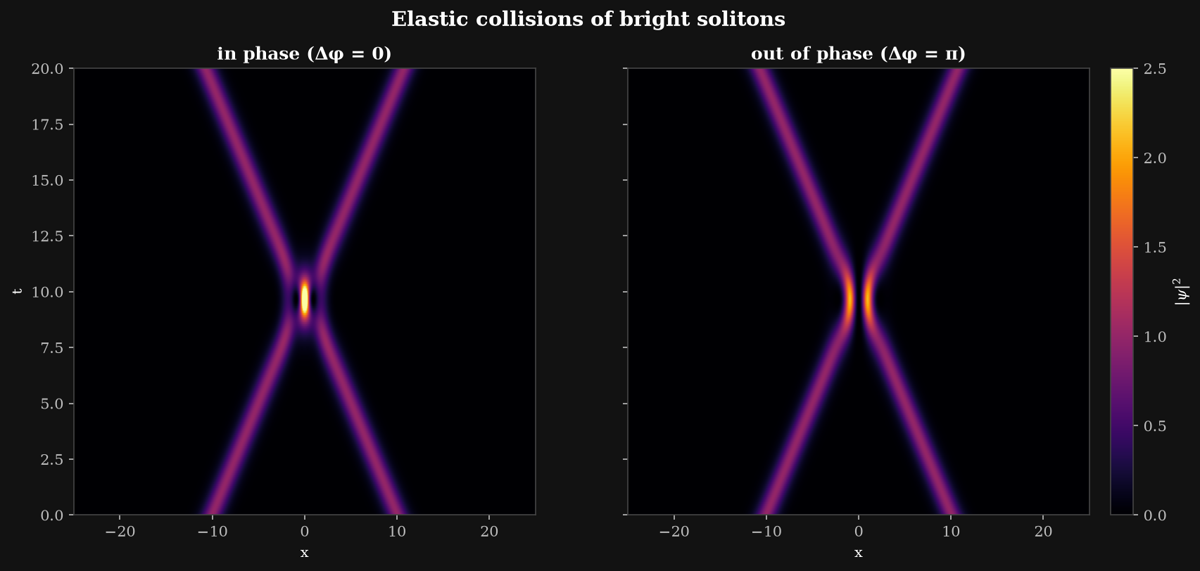
9. Bright soliton collisions
Solitons of the integrable 1D nonlinear Schrödinger equation pass through each other or repel, depending on their relative phase, and emerge unchanged. Norm and energy are conserved to 10 digits.
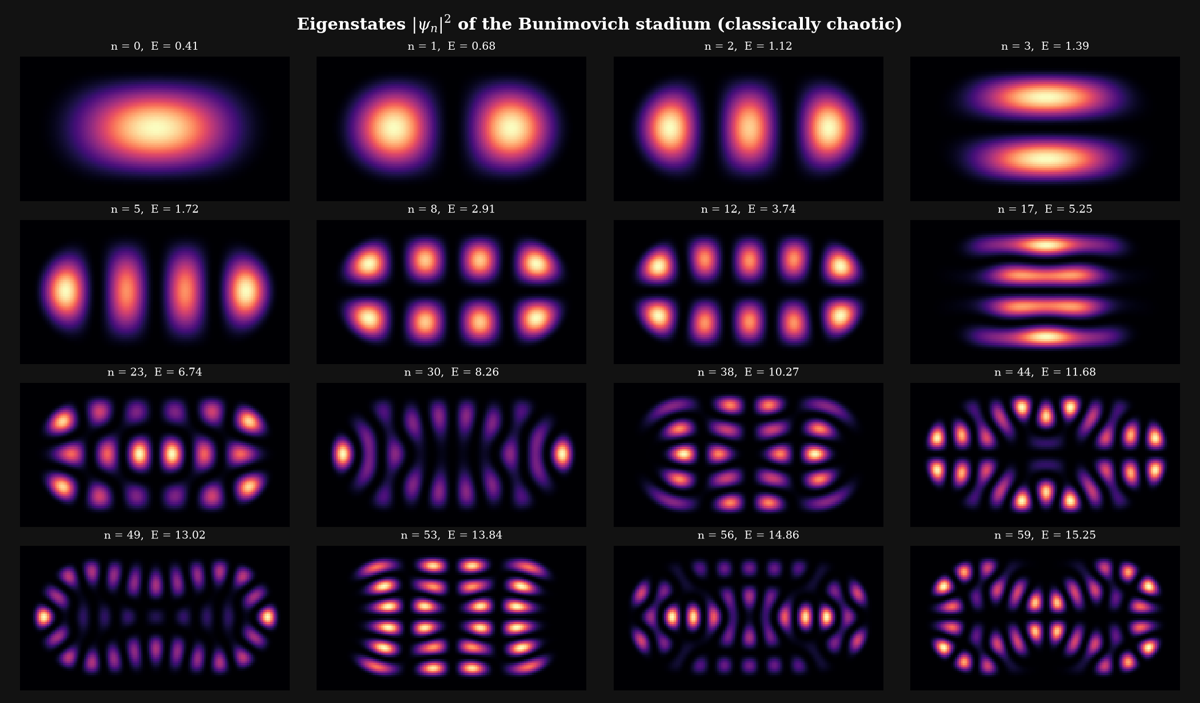
10. Quantum chaos in the stadium billiard
The first 60 eigenstates of a chaotic billiard computed with LOBPCG. LOBPCG and imaginary time agree to 10⁻⁶. The level count N(15.25) = 60 compares with 60.3 from Weyl's law.
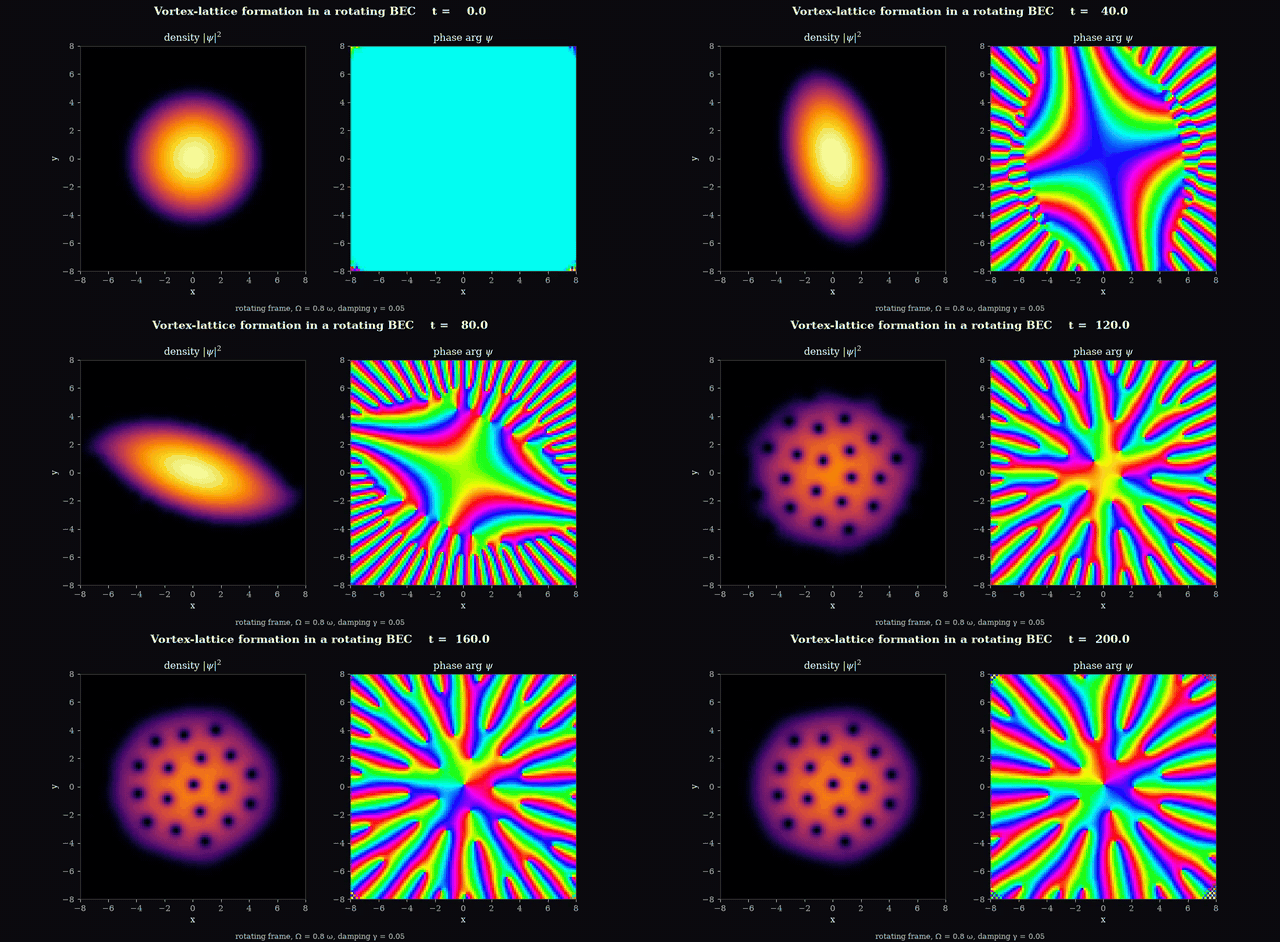
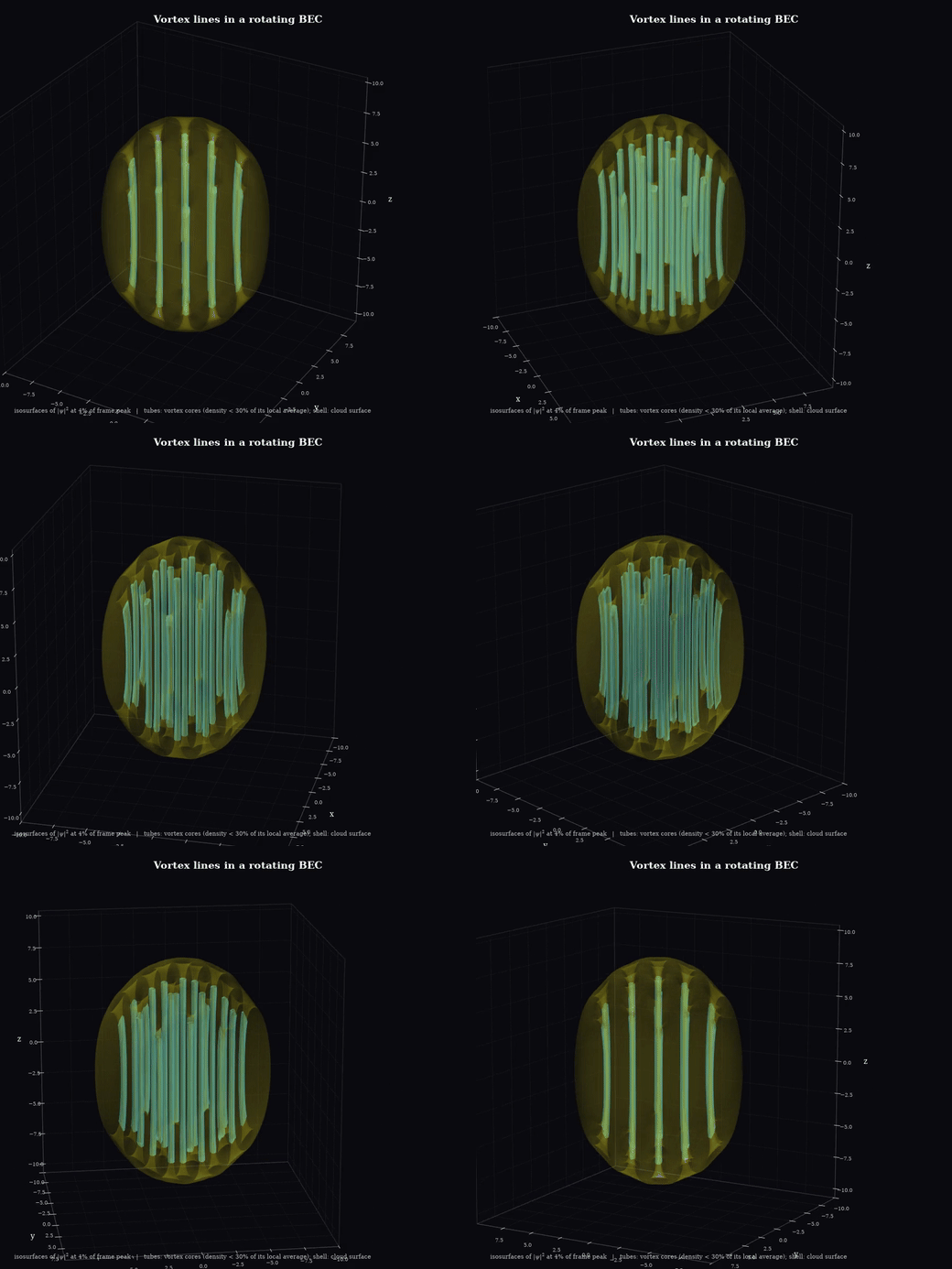
11. Vortex lattice in a rotating BEC
A condensate in a rotating, slightly anisotropic trap develops surface instabilities. Vortices then enter and crystallise into a triangular lattice of 18 vortices (dissipative GPE, following Tsubota, Kasamatsu & Ueda 2002). The mean lattice spacing is within 4.5% (2D) and 2.7% (3D) of Feynman's rule n_v = mΩ/πℏ, which is exact only for an infinite uniform lattice. The 3D state is found by conjugate-gradient energy minimisation (residual below 10⁻⁶) and shows 19 nearly straight vortex lines.
12. High-harmonic generation in hydrogen
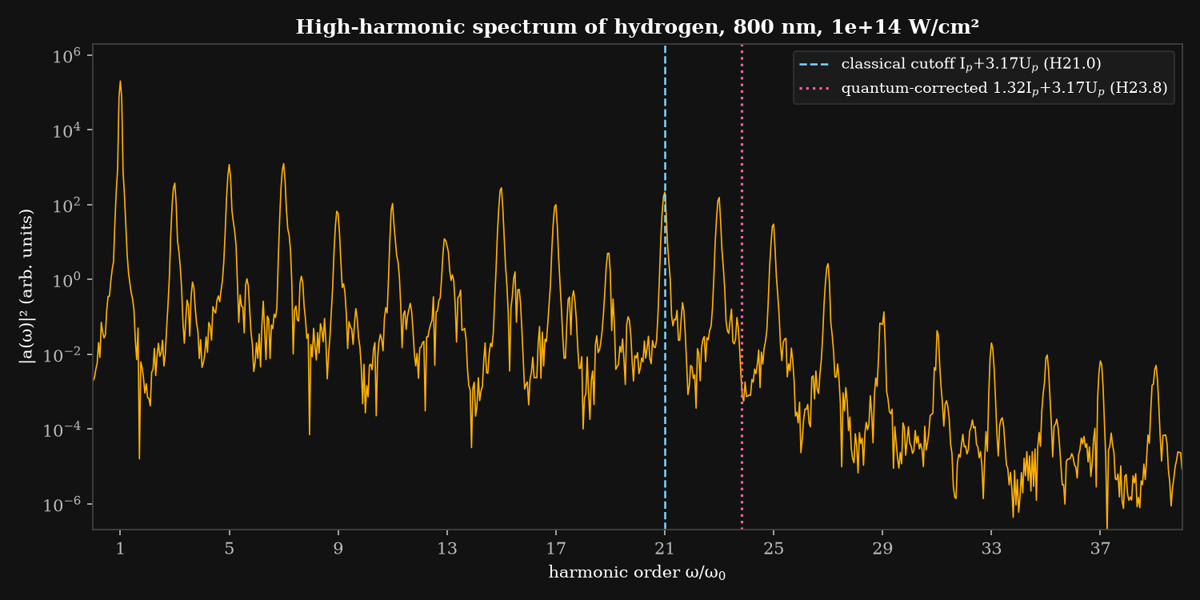
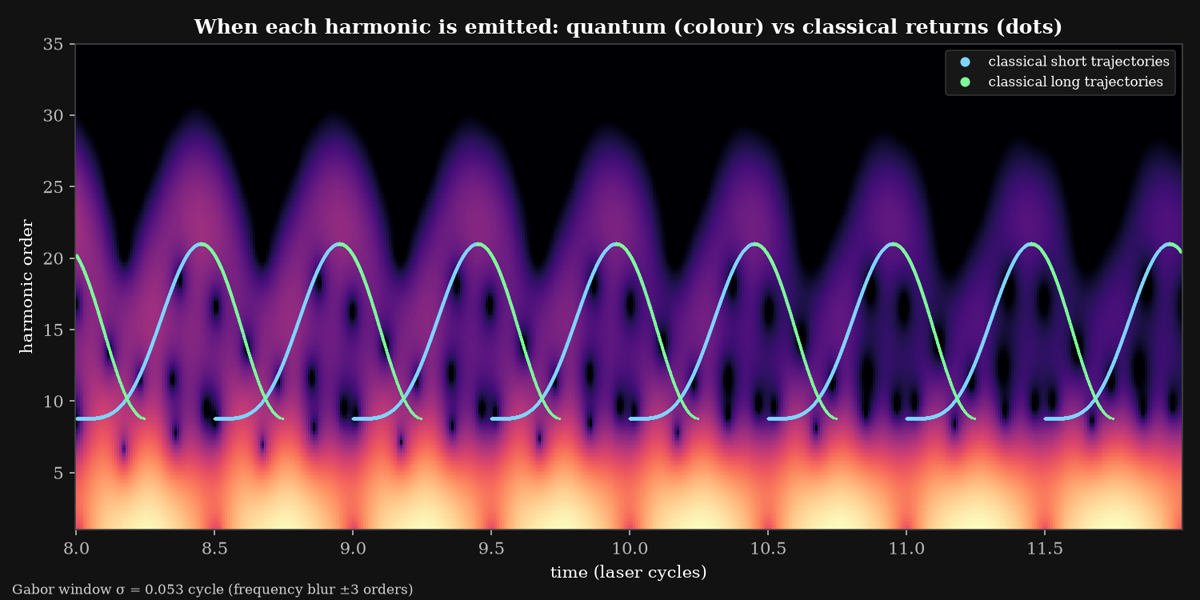
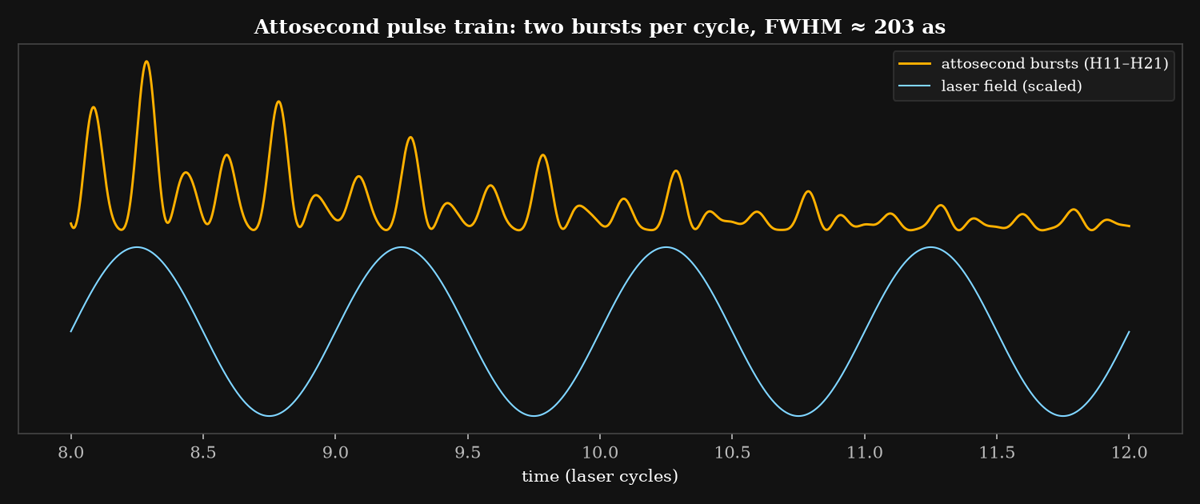
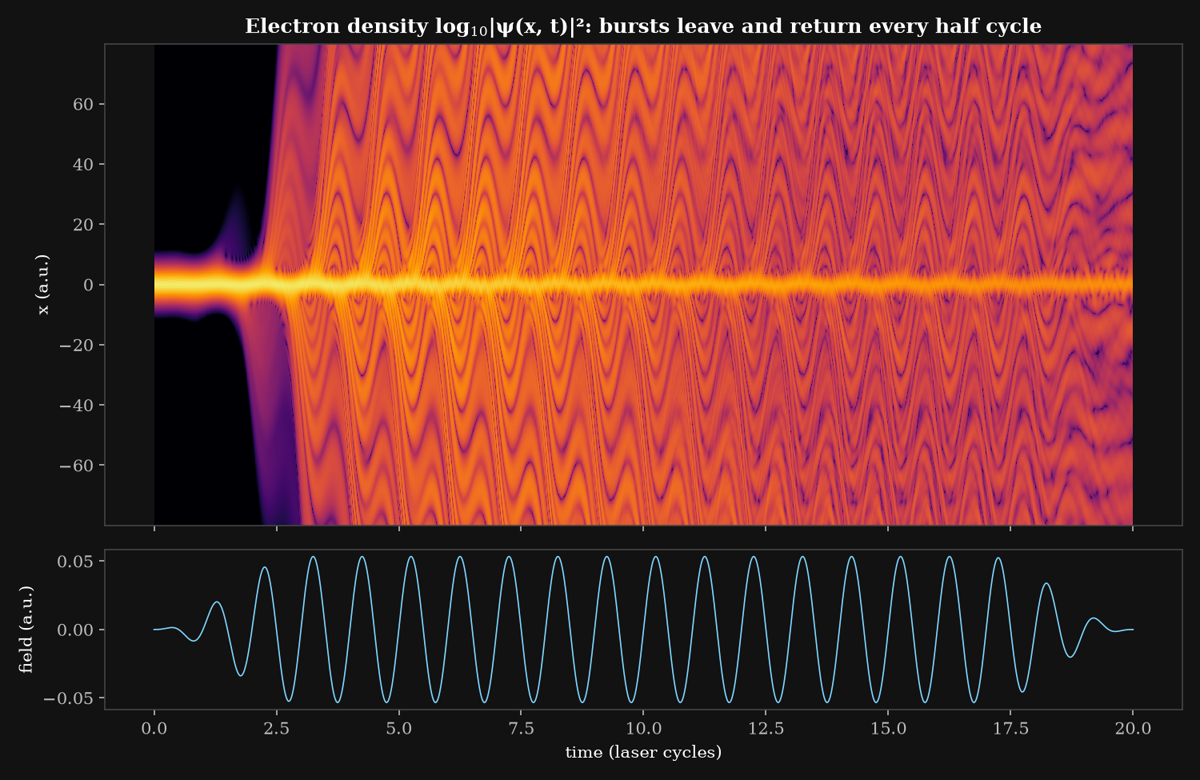
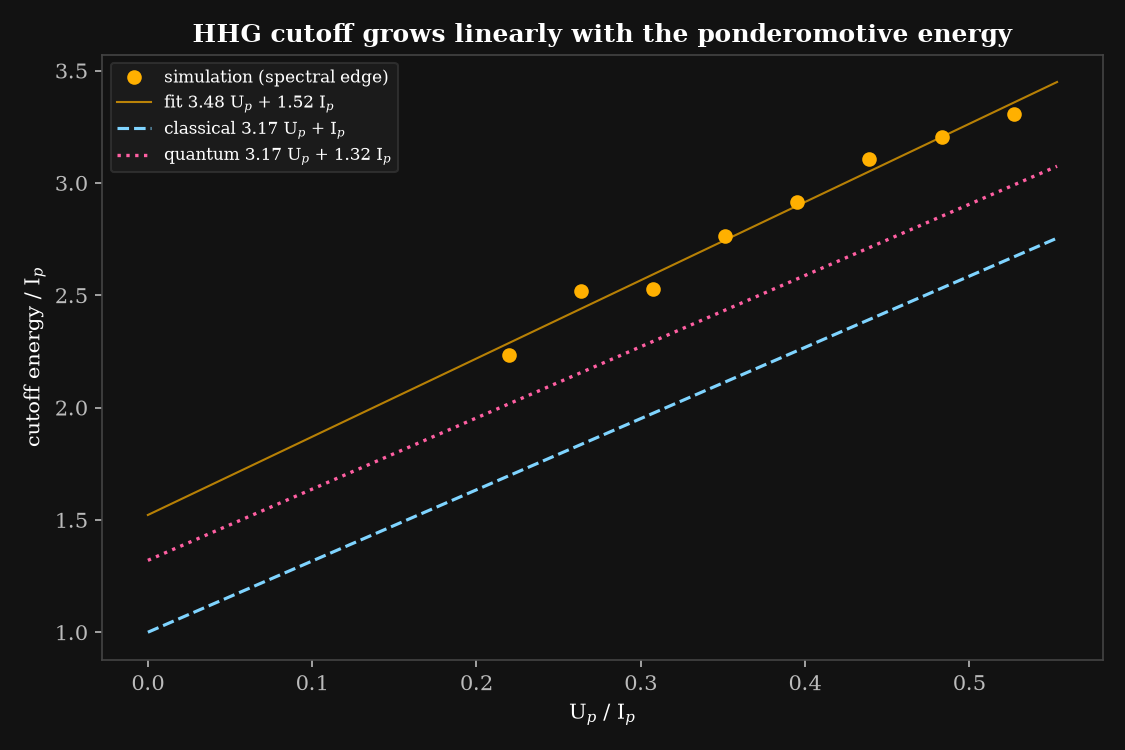
A hydrogen atom (soft-core model, I_p = 13.6 eV) is driven by an 800 nm pulse at 10¹⁴ W/cm². The electron tunnels out, is driven back and recollides, emitting odd harmonics up to a cutoff. - Odd harmonics only: even orders are 2300× weaker, as inversion symmetry requires. - Emission times: each harmonic is emitted when the classical short and long trajectories return, within the 0.05-cycle resolution of the analysis. - Attosecond pulses: filtering H11–H21 gives bursts of about 200 as, one every half cycle (spacing 0.499–0.503 cycle). - Cutoff scaling: an intensity scan shows the cutoff growing linearly with U_p. The fitted spectral edge, 3.48 U_p + 1.52 I_p, lies near the three-step laws, and its exact value depends on how the edge is defined.
13. Two-component condensates
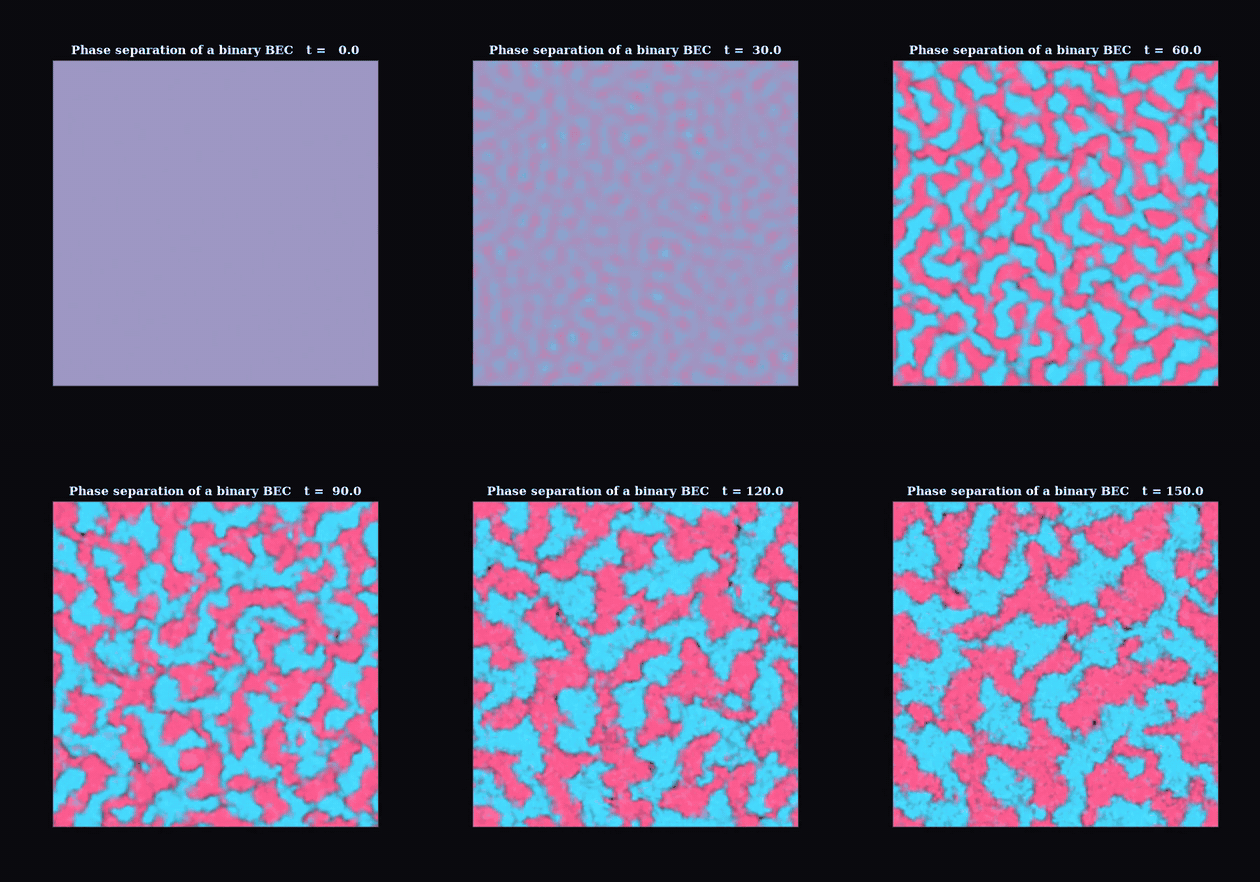
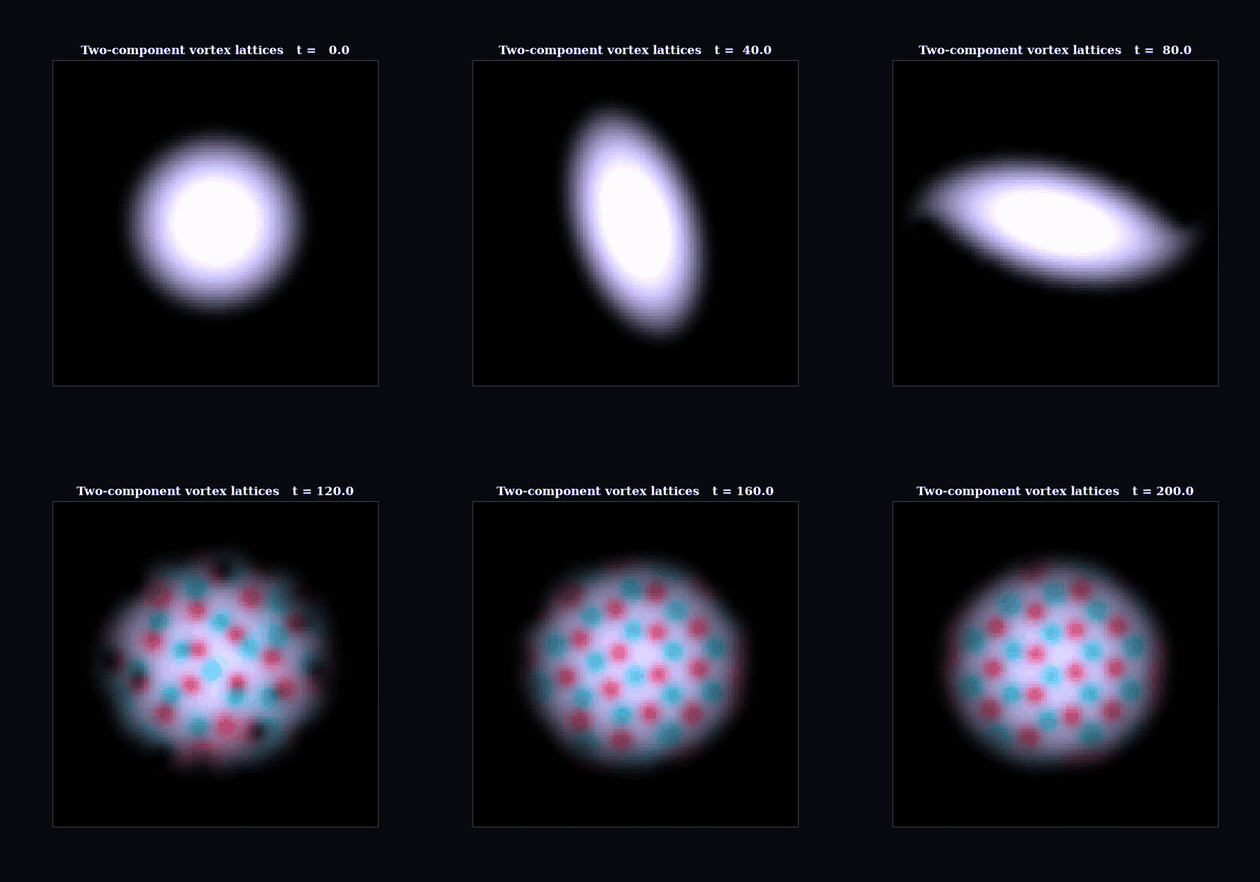
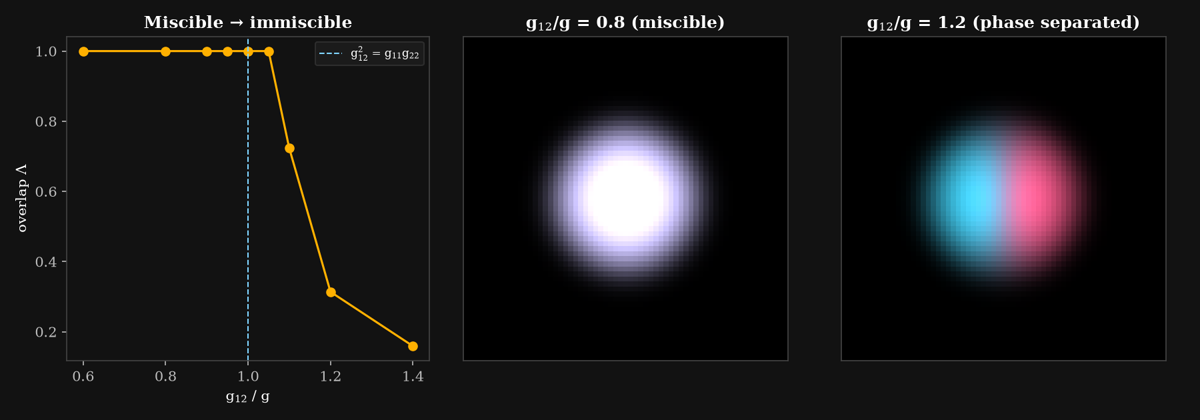
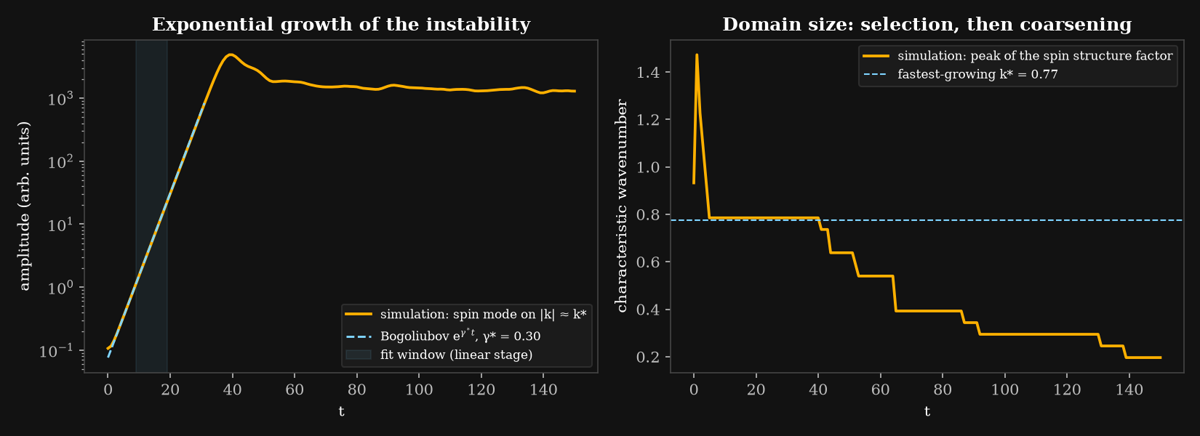
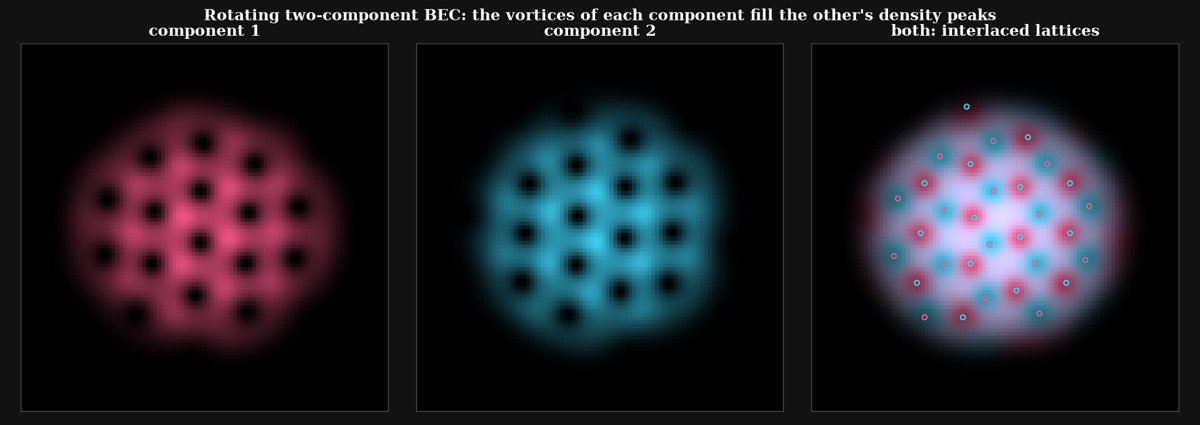
Two condensates with couplings g₁₁ = g₂₂ = g and g₁₂: - Miscibility: in a trap, the overlap of the ground states drops sharply just above g₁₂ = g. The uniform criterion is g₁₂² = g₁₁g₂₂, and a finite cloud shifts the transition slightly upward. - Spinodal decomposition: a uniform mixture with g₁₂ = 1.3g separates into labyrinthine domains. Their growth on the |k| ≈ k* shell matches the Bogoliubov rate γ* = n(g₁₂ − g) to 0.3%, and the structure-factor peak sits at k* within one bin. Afterwards the domains coarsen. - Two-colour vortex lattices: in a rotating trap both components nucleate vortices, which interlace. Every vortex core of one component sits on a density maximum of the other, at a median 1.8× its local average.