QuantumLab
QuantumLab is a Python framework for numerical quantum mechanics. It solves the time-dependent Schrödinger equation and the nonlinear Gross–Pitaevskii equation in 1D, 2D and 3D with split-step Fourier methods, computes stationary states with matrix-free eigensolvers, runs on CUDA GPUs, and renders 3D wavefunctions as animated isosurfaces.
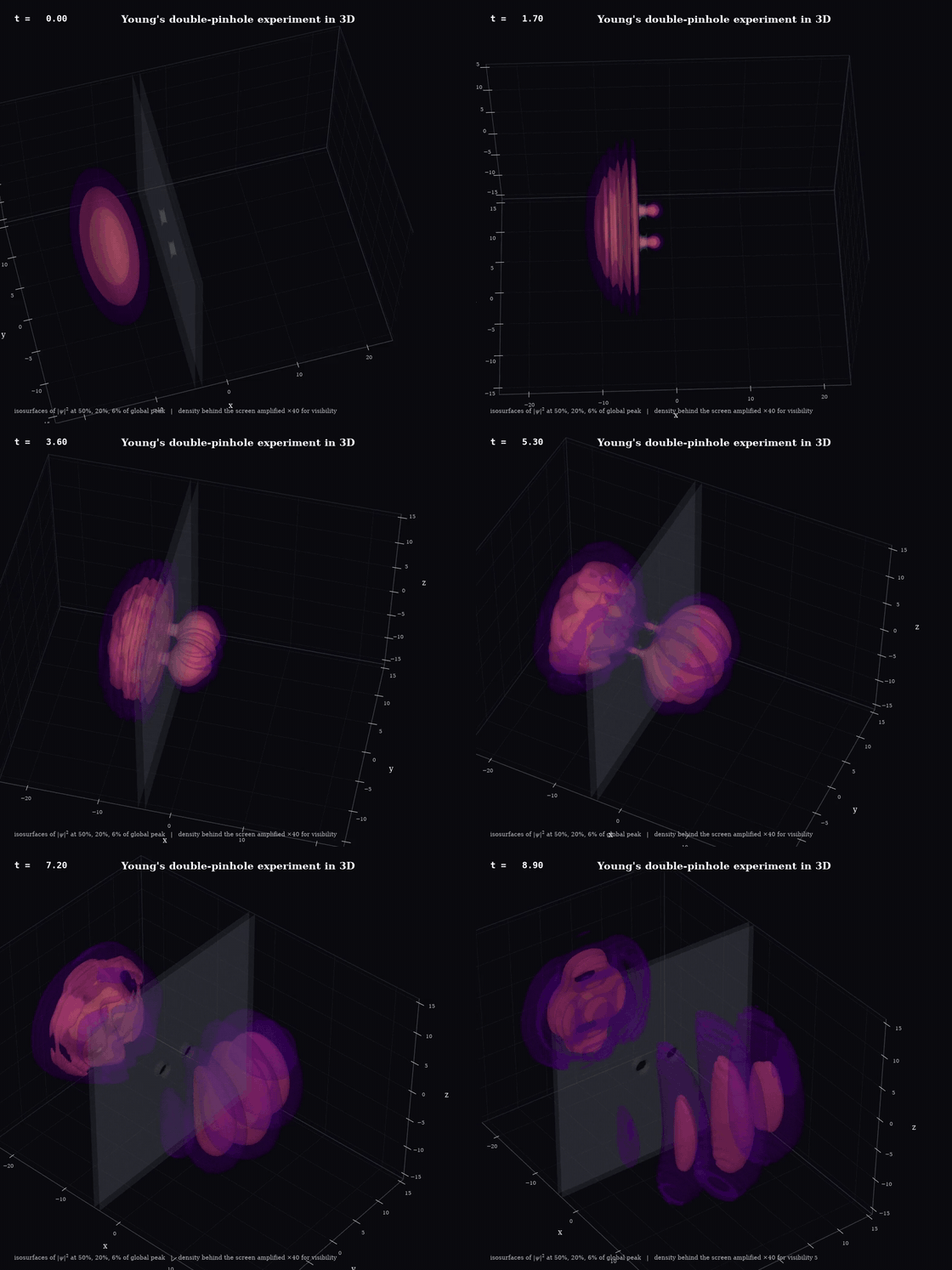
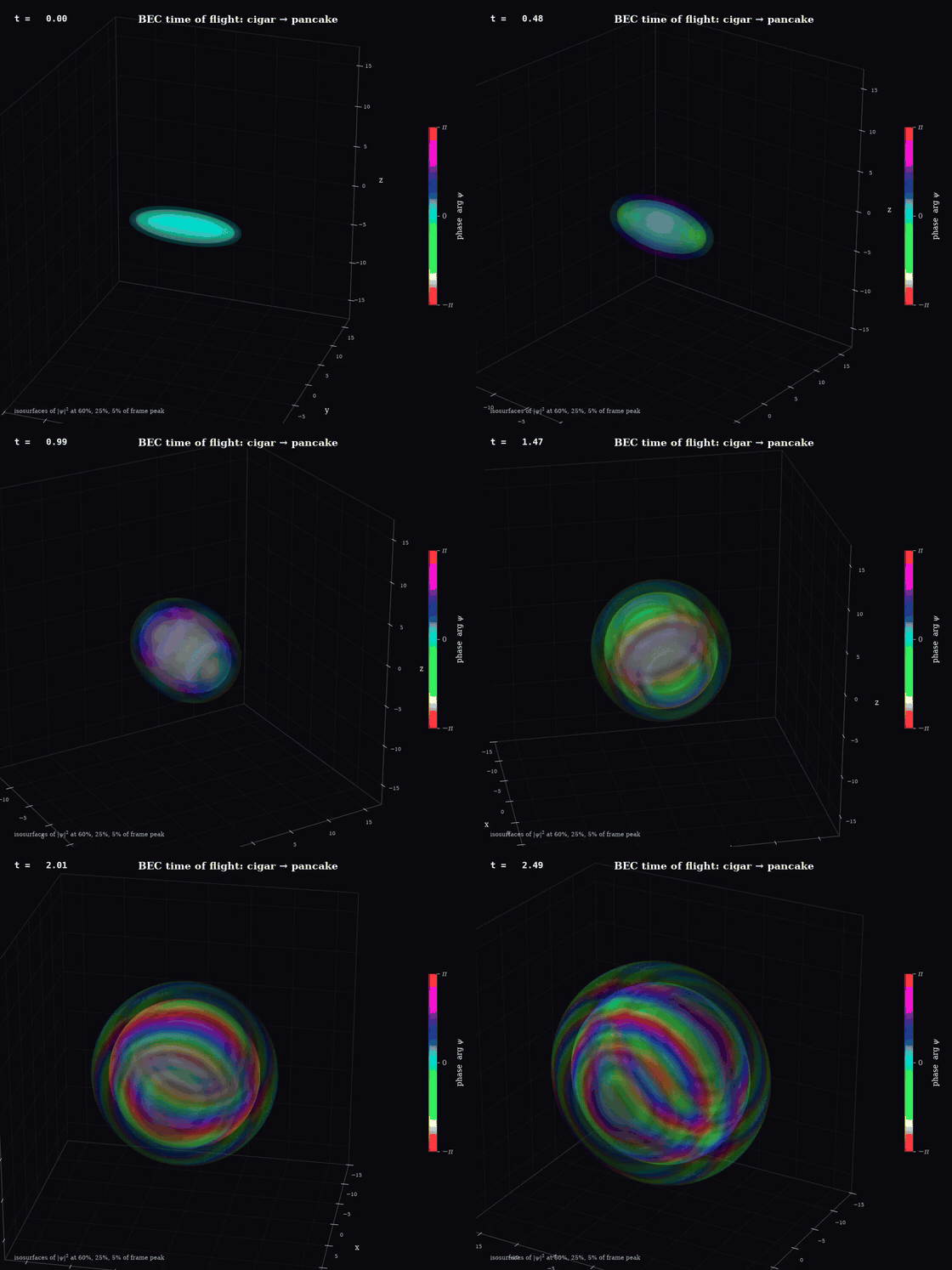
Left: Young's double-pinhole experiment in 3D. Right: a Bose–Einstein condensate released from a cigar-shaped trap, coloured by the quantum phase arg ψ.
What it does
| Area | Capabilities |
|---|---|
| Time evolution | Split-operator propagation of order 2 (Strang) and 4 (Yoshida); time-dependent potentials V(r, t); Gross–Pitaevskii nonlinearity, including coupled multi-component condensates; rotating frames (H − ΩL_z); dissipative dynamics; absorbing boundaries |
| Stationary states | Lanczos and preconditioned LOBPCG eigensolvers on a matrix-free FFT Hamiltonian; imaginary-time ground and excited states, including GP ground states in rotating frames |
| Physics models | Barriers, wells, (anisotropic) harmonic traps, multi-slit and pinhole screens, chaotic stadium billiard, soft-core Coulomb atoms, lattices, disorder, laser-like dipole driving, custom potentials |
| Strong-field physics | High-harmonic spectra, Gabor time–frequency analysis, three-step model, attosecond pulse synthesis |
| Observables | ⟨x⟩, ⟨p⟩, energies, uncertainties, transmission and reflection, probability current, ⟨L_z⟩, autocorrelation spectra, vortex detection |
| Performance | CPU (SciPy FFT, multithreaded) or CUDA GPU through CuPy, 7.6–12.5× faster than Colab's CPU on a Tesla T4 |
| Visualization | Publication-style 1D/2D plots, 3D isosurfaces coloured by phase, orbiting-camera MP4/GIF animations, interactive HTML |
Trustworthy by construction
Every feature is checked against exact, analytic or independent numerical results. Examples include convergence orders 2.001 and 3.997, a driven oscillator against its classical trajectory, harmonic spectra to 10⁻¹³, exact soliton propagation, the Gross–Pitaevskii virial theorem, and exact rotating-frame solutions. The tests run on Python 3.10–3.14 in continuous integration, and the GPU path has been verified on real NVIDIA hardware. See Validation.
Where to go next
- Getting started: installation and a first simulation
- User guide: the solvers, stationary states, potentials and visualization in depth
- Examples: thirteen ready-to-run simulations with their results
- API reference: every class and function, generated from the source